A LITTLE HISTORY
The idea for heat pipes was originally formulated in the 1940s at General Motors but was not developed further until the 60s at Los Alamos National Laboratory and NASA. At that time, heat pipes were primarily used in satellites. By the 80s, some companies started using heat pipes in commercial electronic products such as amplifiers, and in the 90s heats pipes started getting integrated into microcomputers, with the technology going from a specialized industrial product to a consumer product. In 2000, Cooler Master released its first retail CPU air cooler featuring heat pipes, the CHK-5K11. Nowadays, heat pipes are a common technology used in all sorts of products such as laptops, desktops, and smart phones.
A HEAT PIPE BREAKTHROUGH
For a long time, the most common heat pipe construction seen in a CPU cooler has been a copper tube filled with water. Manufacturers have over time developed different variations of sintered, powdered, and composite heat pipes in order to find the most efficient heat pipe construction. Recently however, Cooler Master’s research and development team created a new form of heat pipe known as the superconductive composite heat pipe featuring greatly improved heat transfer performance. Our superconductive composite heat pipes are the pinnacle of heat pipe development thus far, based on many years of research and development, and we are continuously making further improvements on the design.
Cooler Master has used superconductive composite heat pipes in ODM applications for a while but now, with the release of our MA824 Stealth cooler, Cooler Master is starting to implement superconductive composite heat pipes in our consumer PC products.
HOW DO SUPERCONDUCTIVE COMPOSITE HEAT PIPES ACTUALLY WORK?
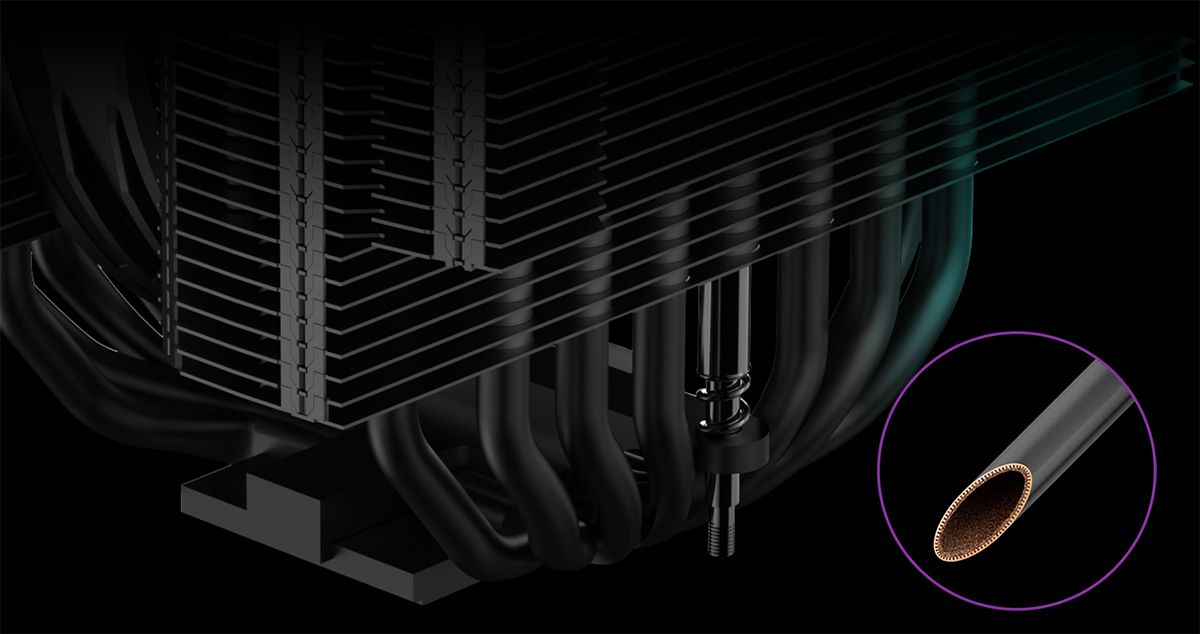
Superconductive composite heat pipes have improved upon traditional heat pipe structures through various mechanisms. The inside of each pipe is coated with a variety of copper-sintered and copper-powdered textures that optimize dissipation efficiency within each pipe and thus overall. Each heat pipe features a very finely textured structure at the bottom evaporator side where it meets the copper base plate that pushes heat up and out. On the condenser side, Cooler Master has used a coarsely textured structure that absorbs liquid like a sponge and helps it move downwards more efficiently, instead of waiting for gravity to pull it down. Cooler Master continues to improve upon and develop its superconductive composite heat pipe technology to improve all aspects of performance, such as maximizing efficiency and wattage per heat pipe, also known as Q-max. Indeed, Cooler Master’s superconductive composite heat pipes feature nearly double the Q-max of regular heat pipes, further indicating how they represent a vast improvement in cooling technologies.
As you can see, advanced heat pipe technology such as superconductive composite heat pipes go a long way in supporting top performance in high power PCs.